
Fresh air is one of the biggest benefits of living in Arizona. Whether you are opening your patio door, French doors, or large sliding glass doors, screens help keep insects and debris outside while letting air flow through your home.
However, choosing the right screen for your doors and windows sounds simple until you are standing in a showroom comparing styles, prices, and installation types, wondering if you are about to make a $500 mistake.
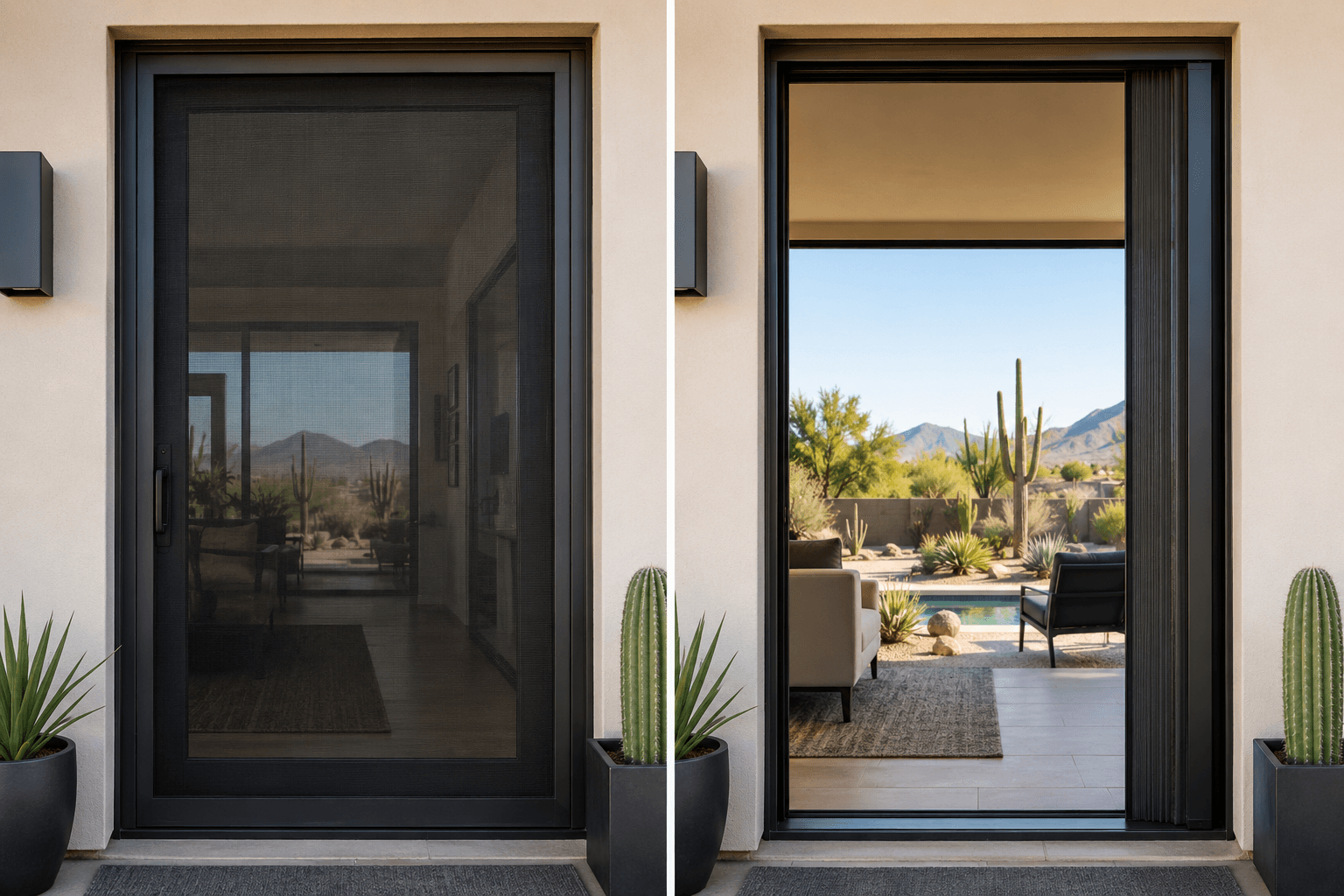
Whether you are retrofitting an older home or upgrading a new one in the Phoenix Metropolitan and White Mountains regions, the decision between retractable screens vs fixed screens is worth thinking through carefully.
Here's what you need to know, broken down in plain terms.
Types of Screens for Doors and Windows
Traditional screens, often called fixed screens, are the kind most Arizonans grew up with. They sit permanently in a frame, attached to your window or door, and do their job quietly year-round. They're simple, affordable, and widely available.
Retractable screens, on the other hand, roll up or slide away when not in use. They're spring-loaded or manually guided into a housing unit mounted beside or above the door frame. When you need airflow, you pull the screen across. When you don't, it disappears.
You can use either type of screen for doors or windows as they solve the same core problem, keeping bugs out while letting fresh air in. But they do it very differently, and that difference matters depending on how you use your space.
Overview: Traditional Screens
Traditional screens stay in place year-round. They are commonly installed on windows, sliding doors, and entry doors. These screens have lasted this long for good reason. They are reliable, low-maintenance, and cost-effective. Once installed, there is very little that can go wrong.
Benefits of Traditional Screens
- Lower upfront cost
- Simple design with fewer moving parts
- Minimal maintenance requirements
- Consistent insect protection
- Available for most window and door styles
Drawbacks of Traditional Screens
- Always visible, even when not needed
- Can block views from inside your home
- May affect the appearance of decorative doors
- Less flexibility for large openings
As a homeowner in the Phoenix Metropolitan and White Mountains regions, if you value simplicity and cost savings, fixed screens are a reliable option.
Overview: Retractable Screens
There is a reason retractable screens have surged in popularity over the last decade. In fact, residential installations dominated in 2025, accounting for 61.4% of total market share.
For Arizona homeowners who have invested in beautiful entryways or statement doors, a permanent screen sitting in front of that craftsmanship feels like putting a screen filter over a great photo. If you face the same issue, retractable screens solve that.
Better Visibility
One of the biggest reasons homeowners choose retractable screens is the unobstructed view. When the screen is not needed, it disappears into its housing, allowing you to enjoy your doors and windows without a visible screen.
Improved Appearance
Retractable screens blend into your home's design. They work particularly well with decorative entry doors and modern glass installations. They are also considered one of the best screens for French doors.
Flexible Use
You can use the retractable screen only when needed. This flexibility allows you to enjoy fresh air while maintaining a clear opening at other times.
Ideal for Large Openings
Many homeowners choose retractable screens for oversized patio doors and multi-panel glass systems where traditional screens may not be practical.
Drawbacks of Retractable Screens
- Higher initial investment
- More moving components
- Periodic maintenance may be required
- Professional installation is usually recommended
While retractable screens cost more upfront, many homeowners appreciate the convenience and appearance they provide.
Retractable Screens Vs Fixed Screens: Side-by-Side Comparison
When comparing retractable screens vs fixed screens, neither option is universally better. The right choice depends on what matters most to you.
What Is the Cost of Retractable Screens?
Entry-level retractable screens start around $150–$300 for a single door. Mid-range options with better housing quality and smoother mechanisms fall between $300–$600.
For wide or custom openings, like French doors or large sliding door spans, expect to pay $600–$1,200 or more, especially with professional installation. Traditional fixed screens, by comparison, often cost less than $200 installed for a standard door.
The price gap is substantial. But retractable screens also add perceived value to your home, last many years when properly maintained even in Arizona’s arid weather, and often come with warranties that fixed screens don't offer at comparable price points.
So, Are Retractable Screens Worth It?
This is the question we hear constantly, and the honest answer is: it depends on what you value.
Retractable screens are worth it if aesthetics and versatility matter to you. If you have got a premium door, a wide opening, or a space where unobstructed views are part of the design intent, the upgrade makes complete sense.
Are they worth it if you're looking for the most economical, set-it-and-forget-it solution? Probably not. A fixed screen will serve you well at a fraction of the cost.
The sweet spot is Arizona homeowners who use their doors selectively, such as entertaining spaces, primary entries, or patio transitions where the screen goes up and down depending on the season or occasion. In those cases, the convenience and clean look of a retractable screen justifies the higher upfront investment.
Get Screens That Fit the Way You Actually Live
There's no universal winner in the retractable screens vs fixed screens debate, and anyone who tells you otherwise is selling you something specific. The right screen is the one that fits your door, your lifestyle, and your home's design without making you compromise on any of them.
Demers Glass works with homeowners in the Phoenix Metropolitan and White Mountains regions, helping them find exactly that fit. We never recommend the trendiest or cheapest option, but one that makes sense for your home and lifestyle. That's how good decisions get made.
Call 866-245-7760 to discuss your requirements or request a personalized quote now.
FAQs
1. Can retractable screens be used on French doors?
Yes, and they are actually one of the best screens for French doors. Dual retractable screens can be configured to meet in the center, allowing both doors to function normally while keeping insects out when needed.
2. How long do retractable screens typically last?
With proper use and maintenance, quality retractable screens can last 10–15 years. Keeping the tracks clean and the mechanism free of debris goes a long way toward extending their lifespan.
3. Are retractable screens easy to repair if damaged?
The screen mesh itself can usually be replaced without replacing the entire unit. Mechanism repairs, however, are more complex and may require a professional. This is another reason you need quality, professional installation.
4. Do retractable screens work in high-wind areas?
Most retractable screens are designed for moderate conditions. In consistently windy environments, which can be common in many parts of Arizona, a fixed screen with a sturdy aluminum frame tends to hold up better over time. Ask your installer about wind ratings.
5. Is professional installation really necessary for retractable screens?
It is not strictly required, but strongly recommended. Precision matters with retractable screens because even a slight misalignment affects how smoothly the screen operates and how well it seals. Professional installation protects your investment.